The Victory of Awareness: Vijayadashami Through Yoga, Meditation, and Daily Sadhana
The Victory of Awareness: Vijayadashami Through Yoga, Meditation, and Daily Sadhana
Discover the deeper meaning of Vijayadashami through yoga, mindful breathing, meditation, and the daily discipline that nurtures inner peace, clarity, and spiritual awareness.
Vijayadashami inspires us to embrace new beginnings, strengthen our resolve, and move forward with confidence. Its timeless message of victory can become a meaningful part of everyday life when we bring awareness to our thoughts, balance to our actions, and dedication to our personal growth.
Through yoga, we learn to unite the body, breath, and mind. Through meditation, we cultivate inner stillness. Through daily sadhana, we transform inspiration into a consistent way of living.
At Yogalaya Vedic, this journey reflects the essence of traditional yogic practice: developing a steady body, a peaceful mind, a compassionate heart, and a deeper connection with the universal consciousness.
Vijayadashami offers a beautiful opportunity to begin or renew this journey. Every mindful breath, every balanced posture, and every moment of meditation becomes a step toward greater awareness.
Key Takeaways
- Embrace new beginnings: Let Vijayadashami inspire a fresh commitment to personal growth and spiritual development.
- Build a regular yoga practice: Combine asanas, pranayama, and meditation to nurture physical balance and mental clarity.
- Progress at your own pace: Adapt yoga practices to your experience, comfort, and individual needs.
- Make sadhana a daily habit: Consistency helps bring the lessons of yoga into everyday decisions and relationships.
- Cultivate inner awareness: Develop the ability to respond to life’s challenges with patience, understanding, and balance.
- Celebrate progress: Each day of sincere practice is an opportunity to deepen self-awareness and strengthen your commitment.
The Spiritual Significance of Vijayadashami
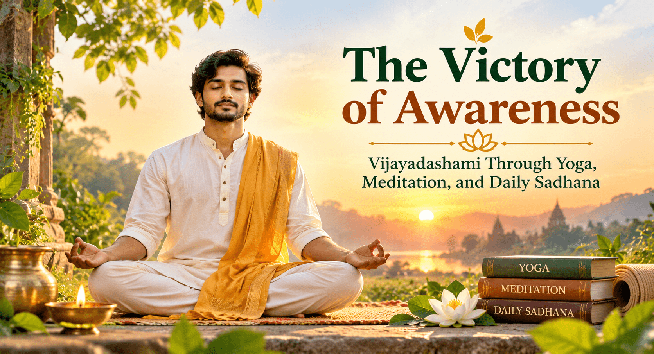
Vijayadashami holds a special place in India’s spiritual and cultural traditions. It is associated with victory, renewal, courage, wisdom, and the fulfillment of purposeful action.
Across communities, the festival is celebrated through different customs and stories. Its universal message offers an opportunity to reflect on the qualities we wish to cultivate within ourselves: clarity in our thinking, courage in our actions, kindness in our relationships, and discipline in our daily lives.
Yoga provides a practical way to nurture these qualities.
When we stand steadily in an asana, we develop balance and awareness. When we practice pranayama, we give our attention a steady rhythm. When we meditate, we create space for reflection and understanding.
These practices help us carry the spirit of Vijayadashami beyond a single day and into the way we live throughout the year.
Reflection: May this Vijayadashami inspire me to live with clarity, courage, compassion, and conscious purpose.
The Yogic Meaning of Inner Victory
In the yogic tradition, personal transformation develops through regular practice, self-study, discipline, and awareness.
Inner victory begins when we become more conscious of our habits and gradually cultivate responses that reflect our deepest values.
- Patience grows when we pause before reacting.
- Focus develops when we return our attention to the present moment.
- Courage strengthens when we approach difficulties with steadiness.
- Compassion deepens when we listen with understanding.
- Self-discipline develops when we honor the commitments that support our well-being.
Yoga helps bring these qualities into practical experience. Each session offers an opportunity to observe the body, regulate the breath, and understand the movements of the mind.
Over time, the benefits of practice can extend into work, family life, relationships, and personal responsibilities.
Affirmation: With every day of practice, I cultivate greater awareness, steadiness, and wisdom.
The Inner Journey from Muladhara to Sahasrara
The chakra system provides a traditional yogic framework for reflecting on different dimensions of human experience, from stability and vitality to insight and spiritual awareness.
The journey through the chakras can be approached as a gradual process of self-understanding. Each stage invites us to reflect on the qualities we are cultivating.
- Muladhara Chakra: Stability, grounding, and a sense of security.
- Svadhisthana Chakra: Creativity, adaptability, and emotional awareness.
- Manipura Chakra: Confidence, determination, and purposeful action.
- Anahata Chakra: Compassion, kindness, and emotional balance.
- Vishuddha Chakra: Authentic expression and mindful communication.
- Ajna Chakra: Concentration, discernment, and inner insight.
- Sahasrara Chakra: Spiritual awareness, contemplation, and a sense of connection with universal consciousness.
These traditional associations can provide a meaningful structure for personal reflection. Practitioners may explore them through meditation, breath awareness, ethical living, and sustained yoga practice.
Vijayadashami offers a fitting moment to reflect on this journey. It reminds us that growth unfolds through the choices we make and the qualities we nurture every day.
Explore the related Yogalaya Vedic articles:
- Ajna Chakra: Cultivating Intuition, Focus, Mental Clarity, and Inner Awareness Through Yoga
- Sahasrara Chakra: Spiritual Awareness, Inner Peace, Wisdom, and Divine Connection Through Yoga
- Beyond the Crown: Sahasrara Chakra, Divine Energy, and Cosmic Awareness
Reflection: I honor each step of my journey and allow awareness to deepen through consistent practice.
Vijayadashami Through Asana, Pranayama, and Meditation
Yoga offers three practical ways to nurture awareness: asana, pranayama, and meditation.
Asana: Cultivating Stability and Strength
Asanas develop body awareness, balance, flexibility, and strength. Each posture encourages us to pay attention to alignment, breathing, and the sensations within the body. A steady posture also provides an opportunity to practise patience. We learn to respect our present abilities while gradually developing greater stability.
Pranayama: Cultivating the Rhythm of Breath
Pranayama brings conscious attention to breathing. Gentle breathing practices can help establish a calmer rhythm and prepare the mind for meditation. By practicing regularly, we learn to notice our breathing patterns and respond to moments of tension with greater awareness.
Meditation: Cultivating Inner Clarity
Meditation provides time to observe thoughts, emotions, and sensations with steady attention. A few minutes of daily meditation can become a valuable part of a balanced routine. With regular practice, meditation encourages a more thoughtful relationship with everyday experiences.
Affirmation: My body grows steadier, my breath becomes more conscious, and my mind learns to rest in awareness.
Mantra Chanting and Silence Meditation
Mantra chanting and silent meditation are traditional practices that help focus attention and establish a contemplative atmosphere.
Om Chanting
Om is a sacred sound used in several Indian spiritual traditions. Practitioners may use it as a focal point for meditation.
How to practise
- Sit comfortably with your spine naturally upright.
- Relax your shoulders, jaw, and facial muscles.
- Take two or three comfortable breaths.
- Inhale gently and chant Om at a natural volume while exhaling.
- Allow the sound to fade naturally.
- Sit quietly and observe the sensations that remain.
- Repeat for three to five minutes, according to your comfort.
Allow the sound to be smooth and unforced. If chanting is uncomfortable, silently repeat the mantra or practice observing your breath.
Affirmation: With every breath, I return to the present moment.
Soham Breath Meditation
Soham is a traditional contemplative mantra often associated with the natural rhythm of breathing.
How to practise
- Sit in a comfortable position.
- Notice the natural inhalation and exhalation.
- Silently associate “so” with inhalation.
- Silently associate “ham” with exhalation.
- Let the breathing remain natural.
- When thoughts arise, gently return your attention to the breath and mantra.
- Continue for three to five minutes.
Affirmation: I rest in the rhythm of my breath and deepen my awareness of the present.
Silence Meditation
After chanting, remain seated in silence for two to five minutes. Notice the breath, sounds around you, and sensations in the body. Let your attention settle naturally. Close by reflecting on one quality you wish to cultivate throughout the day, such as patience, courage, kindness, or clarity.
A Complete 45-Minute Vijayadashami Yoga Sadhana
This practice combines gentle warm-ups, ten asanas, six breathing practices, meditation, and a closing intention.
It is designed to offer different levels of participation. Beginners can use supports and shorter holds, while experienced practitioners can explore the suggested progressions when their alignment, strength, and breathing remain comfortable.
The 45-Minute Schedule
| Practice | Duration |
|---|---|
| Centering and intention | 3 minutes |
| Gentle warm-up | 5 minutes |
| Ten asanas | 19 minutes |
| Six pranayama and breathing practices | 9 minutes |
| Meditation | 6 minutes |
| Closing affirmation and intention | 3 minutes |
| Total | 45 minutes |
The durations are approximate. Move at a pace that allows comfortable breathing and safe transitions.
Part A: Centering and Intention — 3 Minutes
Sit on a yoga mat or a stable chair. Allow your spine to lengthen naturally and rest your hands on your thighs. Close your eyes if comfortable, or keep your gaze softly lowered. Notice the movement of your breath without trying to change it. Relax your forehead, shoulders, and hands.
Intention: Today, I dedicate my practice to awareness, balance, and positive action.
Affirmation: I begin this practice with patience and an open heart.
Part B: Gentle Warm-Up — 5 Minutes
1. Gentle Neck and Shoulder Mobility — 2 minutes
- Sit or stand comfortably with your spine upright.
- Gently turn your head to look to the right, then return to the center.
- Repeat to the left.
- Tilt each ear toward its corresponding shoulder without lifting the shoulder.
- Roll the shoulders slowly backward and forward.
- Finish with a few relaxed shoulder-blade movements.
Keep all movements small and controlled. Avoid full neck circles, particularly if they cause discomfort.
Beginner option: Perform the movements seated.
Progression: Coordinate each movement with a slow, natural breath.
Affirmation: I release unnecessary tension and welcome ease into my body.
Image prompt: A realistic yoga instructor demonstrating gentle seated neck and shoulder mobility on a neutral yoga mat, upright posture, natural anatomy, soft daylight, clean studio background, instructional yoga photography, 4:3 aspect ratio.
2. Cat–Cow Pose — Marjaryasana–Bitilasana — 3 minutes
- Begin on your hands and knees.
- Position your wrists approximately beneath your shoulders and your knees beneath your hips.
- Inhale and gently broaden your chest, allowing your spine to extend comfortably.
- Exhale and round your back gently, drawing your abdomen inward.
- Continue moving between these two positions in rhythm with your breathing.
- Finish in a neutral spine position.
Beginner option: Reduce the range of movement or perform the exercise seated with your hands resting on your thighs.
Progression: Coordinate each movement smoothly with the full, comfortable breathing cycle.
Affirmation: With every breath, I cultivate flexibility and awareness.
Image prompt: A realistic yoga instructor demonstrating Cat–Cow Pose on a yoga mat, clearly showing hands beneath shoulders and knees beneath hips, natural spinal movement, side-view instructional composition, accurate anatomy, soft natural lighting, 4:3 aspect ratio.
Part C: Ten Asanas for Inner Balance and Awareness — 19 Minutes
1. Tadasana — Mountain Pose
Duration: 2 minutes
Tadasana develops awareness of standing alignment and provides a foundation for many other standing postures.
Steps
- Stand with your feet hip-width apart or together, whichever feels more stable.
- Distribute your weight evenly across both feet.
- Keep your knees relaxed rather than locked.
- Lengthen your spine and allow your shoulders to relax.
- Let your arms rest beside your body.
- Keep your chin level and gaze forward.
- Breathe naturally while observing your posture.
Beginner option: Stand near a wall or chair for balance.
Progression: Raise your arms overhead while keeping your ribs relaxed and your balance steady.
Benefits: Encourages postural awareness, standing balance, and a grounded beginning to the practice.
Affirmation: I stand with stability, clarity, and confidence.
Image prompt: Photorealistic full-body yoga instructional photograph of an adult practitioner in Tadasana, feet grounded, spine upright, arms beside the body, neutral yoga studio, accurate alignment, natural proportions, soft daylight, 4:3 aspect ratio.
2. Vrikshasana — Tree Pose
Duration: 2 minutes, including both sides
Tree Pose develops balance, concentration, and awareness of the body in space.
Steps
- Stand in Tadasana.
- Shift your weight onto your left foot.
- Place the right toes on the floor and rest the right heel against the left ankle.
- When balanced, move the right foot to the inner calf if comfortable.
- Bring your palms together at your chest.
- Fix your gaze on a stationary point.
- Hold for several comfortable breaths.
- Return to Tadasana and repeat on the other side.
Beginner option: Keep the lifted foot beside the standing ankle and use a wall for support.
Progression: Raise the arms overhead while maintaining steady breathing.
Benefits: Challenges balance, strengthens concentration, and develops lower-body stability.
Affirmation: I remain steady while adapting gracefully to change.
Image prompt: Photorealistic full-body yoga photograph of an adult practitioner in Vrikshasana, one foot placed against the inner calf and palms together at the chest, straight standing leg, clear knee alignment, simple studio background, 4:3 aspect ratio.
3. Utkatasana — Chair Pose
Duration: 2 minutes
Chair Pose develops strength in the legs while inviting awareness of posture and effort.
Steps
- Stand with your feet hip-width apart.
- Inhale and raise your arms to a comfortable height.
- Exhale and bend your knees, moving your hips backward as though sitting on a chair.
- Keep your weight distributed through your feet.
- Allow your torso to incline slightly forward from the hips.
- Keep your chest open and your breathing comfortable.
- Hold briefly, then straighten your legs and lower your arms.
Beginner option: Perform a shallow knee bend or sit back toward an actual chair.
Progression: Gradually deepen the bend while maintaining knee alignment and a stable spine.
Benefits: Strengthens the thighs and gluteal muscles and challenges postural control.
Affirmation: I meet each challenge with strength, patience, and determination.
Image prompt: Photorealistic yoga instructional photograph of an adult practitioner in Utkatasana, hips moving backward, knees bent comfortably, arms raised, spine long, heels grounded, anatomically accurate alignment, neutral studio, 4:3 aspect ratio.
4. Trikonasana — Triangle Pose
Duration: 2 minutes, including both sides
Triangle Pose develops lateral flexibility and awareness of alignment.
Steps
- Stand with your feet comfortably wide apart.
- Turn your right foot outward and angle the left foot slightly inward.
- Extend your arms to the sides at shoulder height.
- Lengthen your torso toward the right.
- Rest your right hand on your shin, a yoga block, or a suitable support.
- Extend your left arm upward if comfortable.
- Keep your chest open and breathe naturally.
- Return to standing and repeat on the other side.
Beginner option: Place your lower hand on a block or keep the range of movement small.
Progression: Refine the alignment and lengthen through both sides of the torso without forcing the stretch.
Benefits: Encourages lateral mobility, balance, and awareness of the legs and torso.
Affirmation: I create space for new perspectives and greater understanding.
Image prompt: Photorealistic full-body yoga photograph of an adult practitioner in Trikonasana, feet wide, front hand supported on a yoga block, opposite arm extended upward, chest open, accurate alignment, neutral studio, 4:3 aspect ratio.
5. Virabhadrasana II — Warrior II
Duration: 2 minutes, including both sides
Warrior II encourages lower-body strength, concentration, and a steady sense of direction.
Steps
- Stand with your feet wide apart.
- Turn the right foot outward and angle the left foot slightly inward.
- Bend your right knee comfortably while keeping the left leg extended.
- Align the right knee in the direction of the right toes.
- Extend both arms at shoulder height.
- Look forward over your right hand.
- Keep your torso upright and shoulders relaxed.
- Hold for several comfortable breaths, then switch sides.
Beginner option: Shorten the stance and use a shallower knee bend.
Progression: Increase the depth of the front knee bend gradually while preserving alignment.
Benefits: Develops leg strength, stamina, and focused attention.
Affirmation: I move forward with courage, balance, and purposeful action.
Image prompt: Photorealistic full-body yoga photograph of an adult practitioner in Virabhadrasana II, wide stance, front knee comfortably bent and aligned with toes, arms extended horizontally, torso upright, accurate anatomy, 4:3 aspect ratio.
6. Adho Mukha Svanasana — Downward-Facing Dog
Duration: 2 minutes
Downward-Facing Dog develops coordination and strength through the shoulders, arms, and legs while stretching the back of the body.
Steps
- Begin on your hands and knees.
- Spread your fingers and press your hands into the mat.
- Tuck your toes and lift your hips upward and backward.
- Lengthen your spine and allow your head to rest naturally between your arms.
- Keep your knees bent as much as needed to maintain a long spine.
- Press through your hands without locking your elbows.
- Breathe comfortably.
- Lower your knees to return to the starting position.
Beginner option: Practise with your hands against a wall, forming a comfortable angled position.
Progression: Refine shoulder stability and spinal length without forcing your heels toward the floor.
Benefits: Builds upper-body and leg strength and encourages whole-body coordination.
Affirmation: I create strength through steadiness and space through awareness.
Image prompt: Photorealistic yoga instructional photograph of an adult practitioner in Adho Mukha Svanasana, hands grounded, hips lifted, spine long, knees slightly bent, head relaxed, anatomically accurate form, side view, 4:3 aspect ratio.
7. Bhujangasana — Cobra Pose
Duration: 2 minutes
Cobra Pose gently extends the spine and develops awareness of the chest, shoulders, and back.
Steps
- Lie on your stomach with your legs extended comfortably.
- Place your palms near the lower ribs.
- Keep your elbows close to your body.
- Inhale and gently lift your head and chest using your back muscles.
- Press lightly through your hands as needed.
- Keep your pelvis grounded and shoulders away from your ears.
- Maintain a comfortable height and breathe naturally.
- Exhale and lower yourself slowly.
Beginner option: Practise a very low cobra with your elbows bent.
Progression: Lift the chest slightly higher while maintaining a relaxed neck.
Benefits: Encourages spinal extension, chest mobility, and awareness of back-muscle engagement.
Affirmation: I open myself to fresh energy, confidence, and possibility.
Image prompt: Photorealistic yoga photograph of an adult practitioner in a low Bhujangasana, lying prone, palms near ribs, elbows softly bent, chest gently lifted, pelvis grounded, relaxed shoulders, accurate anatomy, 4:3 aspect ratio.
8. Setu Bandhasana — Bridge Pose
Duration: 2 minutes
Bridge Pose develops awareness of the hips, legs, and spinal alignment.
Steps
- Lie on your back with your knees bent.
- Place your feet hip-width apart and keep them grounded.
- Rest your arms beside your body.
- Inhale and lift your hips gradually.
- Keep your knees pointing forward.
- Maintain a comfortable position without turning your head.
- Breathe naturally.
- Exhale and lower your spine slowly.
Beginner option: Lift the hips only a small distance.
Progression: Maintain the full bridge with steady alignment, under appropriate instruction.
Benefits: Strengthens the hips and legs and encourages controlled spinal movement.
Affirmation: I build a strong foundation for balanced growth.
Image prompt: Photorealistic yoga instructional photograph of an adult practitioner in Setu Bandhasana, lying supine, knees bent, feet hip-width apart, hips lifted, shoulders grounded, neck neutral, accurate anatomy, 4:3 aspect ratio.
9. Balasana — Child’s Pose
Duration: 2 minutes
Child’s Pose offers an opportunity to rest, observe the breath, and settle after the standing and strengthening postures.
Steps
- Begin on your hands and knees.
- Bring your hips gently toward your heels.
- Allow your torso to rest toward your thighs.
- Extend your arms forward or place them beside your body.
- Rest your forehead on the mat or a cushion.
- Breathe comfortably and relax your shoulders.
- Return to an upright position slowly.
Beginner option: Place a cushion beneath your chest or forehead, and use a comfortable knee position.
Progression: Refine the posture through relaxed breathing and sustained awareness rather than forcing a deeper fold.
Benefits: Provides a resting position and encourages relaxation.
Affirmation: I allow myself to pause, restore, and begin again with clarity.
Image prompt: Photorealistic yoga photograph of an adult practitioner in Balasana, hips moving toward heels, torso supported over thighs, forehead resting on a cushion, arms extended comfortably, serene yoga studio, 4:3 aspect ratio.
10. Sukhasana — Easy Seated Pose
Duration: 1 minute
Sukhasana provides a comfortable position for breathing, meditation, and reflection.
Steps
- Sit cross-legged on a folded blanket or yoga cushion.
- Allow your knees to rest comfortably.
- Lengthen your spine without stiffening your back.
- Relax your shoulders and hands.
- Rest your palms on your thighs.
- Keep your gaze soft or close your eyes.
- Observe the natural rhythm of your breathing.
Beginner option: Sit on a stable chair with both feet on the floor.
Progression: Deepen your meditation through sustained attention and relaxed breathing.
Benefits: Provides a stable position for contemplation and breath awareness.
Affirmation: I welcome stillness, clarity, and inner balance.
Image prompt: Photorealistic yoga instructional photograph of an adult practitioner seated in Sukhasana on a folded meditation cushion, upright relaxed spine, hands on knees, natural facial expression, soft daylight, uncluttered background, 4:3 aspect ratio.
Six Pranayama and Breathing Practices for Daily Sadhana
The following sequence introduces conscious breathing gradually, from simple observation to traditional pranayama techniques. The nine-minute breathing section uses short rounds. Beginners can practise fewer rounds and extend the duration over time.
1. Natural Diaphragmatic Breathing — 1 minute
This practice helps you become familiar with the natural movement of the breath.
- Sit comfortably or lie on your back if that position suits you.
- Place one hand on your abdomen.
- Breathe naturally through your nose if comfortable.
- Notice the gentle movement of the abdomen during inhalation and exhalation.
- Allow the breath to remain effortless.
Affirmation: I meet each breath with calm attention.
2. Three-Part Yogic Breathing — 1 minute
Three-part breathing develops awareness of the abdomen, rib cage, and upper chest.
- Sit comfortably with your spine upright.
- Inhale gently, noticing the abdomen expand.
- Continue the inhalation by noticing the ribs widen.
- Allow a small, natural expansion of the upper chest.
- Exhale smoothly without forcing the breath.
- Repeat for several comfortable rounds.
Beginner option: Focus on the abdomen and ribs.
Progression: Coordinate the three areas with a smooth, unstrained breath.
Affirmation: My breath becomes a bridge between body and awareness.
3. Sama Vritti — Equal Breathing — 1 minute
Sama Vritti involves gently balancing the length of the inhalation and exhalation.
- Sit comfortably.
- Inhale gently for a count of three.
- Exhale gently for a count of three.
- Continue at a pace that feels natural.
- If counting creates tension, return to uncounted breathing.
As comfort develops, you may gradually increase the count while keeping the breathing smooth.
Affirmation: I cultivate balance in my breathing, thoughts, and actions.
4. Nadi Shodhana — Alternate-Nostril Breathing — 2 minutes
Nadi Shodhana is a traditional breathing practice involving alternate nostrils. It can serve as a preparation for meditation.
- Sit upright with your shoulders relaxed.
- Rest your left hand on your thigh.
- Use your right hand to gently manage airflow through the nostrils.
- Close the right nostril and inhale through the left.
- Close the left nostril, release the right, and exhale through the right.
- Inhale through the right.
- Close the right nostril, release the left, and exhale through the left.
- This completes one round. Continue slowly for the allotted time.
Keep the breath gentle and avoid forceful inhalations or exhalations. Practise without breath retention.
Affirmation: I cultivate steadiness and clarity with every balanced breath.
5. Bhramari — Humming-Bee Breathing — 2 minutes
Bhramari uses a gentle humming sound during exhalation and can create a calming focus for attention.
- Sit comfortably with your spine upright.
- Relax your jaw and shoulders.
- Inhale gently through your nose.
- Exhale while making a soft, continuous humming sound.
- Notice the vibration around your face and head.
- Allow the next inhalation to arise naturally.
- Repeat for several rounds.
Keep the sound comfortable and the exhalation unforced. Closing your eyes is optional. You do not need to press your ears or apply pressure to your face.
Affirmation: I invite quietness, patience, and clarity into my mind.
6. Sitali or Sitkari — Cooling Breath — 2 minutes
These traditional techniques are sometimes used to cultivate a cooling sensation.
Sitali steps
- Sit comfortably.
- Curl the tongue into a tube if your tongue shape permits.
- Inhale gently through the curled tongue.
- Close the mouth.
- Exhale slowly through the nose.
- Repeat for a few comfortable rounds.
Sitkari alternative
- Rest the teeth lightly together, without clenching.
- Part the lips slightly.
- Inhale gently through the gaps around the teeth.
- Close the mouth and exhale through the nose.
- Repeat comfortably.
If you cannot curl your tongue, choose Sitkari if comfortable, or simply return to natural breathing. Practise in a clean environment and avoid drawing in air that irritates your throat. Skip cooling breath techniques if they cause discomfort or do not suit your circumstances.
Affirmation: I respond to my needs with awareness and care.
The purpose of this sequence is to develop awareness, ease, and steadiness.
Six-Minute Guided Vijayadashami Meditation
After completing your breathing practice, remain seated in Sukhasana or on a chair. This meditation brings together the themes of the festival: renewal, courage, awareness, and purposeful action.
Minute 1: Settle the Body
Allow your body to become comfortable. Relax your shoulders, hands, and facial muscles. Feel the support beneath you and notice the natural rhythm of your breathing.
Minute 2: Observe the Breath
Bring your attention to the sensation of breathing at the nostrils, chest, or abdomen. Let the breath continue naturally.
Minute 3: Cultivate Awareness
Notice the thoughts and feelings that arise. Gently return your attention to the breath whenever your mind wanders.
Minute 4: Reflect on Inner Strength
Bring to mind a quality you wish to develop, such as courage, patience, compassion, or clarity. Consider one practical way to express that quality today.
Minute 5: Connect with Your Intention
Silently repeat: “I choose to act with awareness. I cultivate steadiness in my thoughts and kindness in my actions.” Allow the words to settle.
Minute 6: Rest in Silence
Release the words and sit quietly. Notice your body, breath, and surroundings. When you are ready, open your eyes gently.
Closing affirmation: I carry the stillness of meditation into the movement of daily life.
Three-Minute Closing Affirmation and Intention
Complete the 45-minute routine by returning to a comfortable seated position. Spend the first minute reflecting on one aspect of your practice that felt meaningful.
During the second minute, choose one intention for the day. It might involve listening more patiently, speaking more thoughtfully, completing an important task, or making time for personal well-being.
During the final minute, repeat the following affirmations slowly:
- I welcome new beginnings with courage.
- I nurture awareness through daily practice.
- I respect my body and its needs.
- I use my energy with purpose.
- I cultivate compassion in my relationships.
- I continue learning with patience and humility.
Finish by taking a comfortable breath and carrying your intention into the rest of your day.
Your Daily Sadhana: Turning Inspiration into a Habit
Sadhana refers to a regular spiritual or personal discipline undertaken with sincerity and consistency. A daily sadhana does not need to be complicated. It can begin with a few minutes of conscious breathing and gradually develop into a more complete routine.
Morning Practice
Begin the day with a few moments of quiet reflection. A simple morning routine might include:
- Two minutes of natural breathing.
- Five minutes of gentle mobility.
- Ten minutes of selected asanas.
- Three minutes of pranayama.
- Two minutes of meditation.
- One clear intention for the day.
This shorter practice provides a practical starting point for people with busy schedules.
Evening Practice
In the evening, allow time to reflect on the day. Ask yourself:
- When did I respond with patience?
- What helped me remain focused?
- Where could I have acted with greater awareness?
- What positive action will I take tomorrow?
Use these questions as an invitation to learn and grow.
Affirmation: Every day offers a new opportunity to practise awareness and live with intention.
A Seven-Day Vijayadashami Sadhana Challenge
Use the week following Vijayadashami to establish a regular practice. Each day focuses on one quality and one simple action.
| Day | Theme | Daily Practice |
|---|---|---|
| Day 1 | New beginnings | Complete the 45-minute routine at a comfortable level, or begin with a shorter version. |
| Day 2 | Stability | Practise Tadasana and Vrikshasana with mindful breathing. |
| Day 3 | Strength | Practise Utkatasana and Virabhadrasana II using appropriate modifications. |
| Day 4 | Flexibility | Include Cat–Cow, Triangle Pose, and a gentle Cobra variation. |
| Day 5 | Breath awareness | Practise natural breathing, Sama Vritti, and gentle Nadi Shodhana. |
| Day 6 | Inner stillness | Practise Bhramari, followed by six minutes of meditation. |
| Day 7 | Integration | Complete a suitable full routine and reflect on the habits you want to continue. |
How to Make the Challenge Meaningful
Set aside a consistent time each day. Keep a small journal and record the practice you completed, how you felt, and one thing you learned.
If you miss a day, simply resume the next day. The purpose is to build a sustainable habit and a thoughtful relationship with your practice.
Seven-day commitment: I dedicate time each day to my well-being, awareness, and personal growth.
Bringing the Spirit of Vijayadashami into Everyday Life
Practise Mindful Communication
Listen fully before responding. Give yourself a moment to consider your words and their effect on others.
Develop Thoughtful Habits
Choose routines that support your physical well-being, mental clarity, and responsibilities.
Make Time for Reflection
A few minutes of quiet reflection can help you review your priorities and approach decisions more consciously.
Cultivate Compassion
Extend kindness to yourself and others. Recognise that everyone is learning, adapting, and navigating personal challenges.
Approach Work with Awareness
Give your attention to the task in front of you. Take suitable breaks and return to your work with renewed focus.
Continue Learning
Remain open to guidance, feedback, and new experiences. A regular yoga practice offers opportunities to develop greater self-understanding over time.
Affirmation: I express the values of my practice through the choices I make every day.
The Benefits of Consistent Yoga and Meditation
A balanced yoga practice brings together movement, breathing, and attention. The experience differs from person to person, depending on the practices selected, frequency, health, and individual circumstances.
- Physical well-being: Yoga can help develop flexibility, balance, muscular strength, and body awareness.
- Stress management: Gentle movement, breathing, and meditation can provide structured opportunities to relax and manage everyday stress.
- Mental and emotional well-being: Mindful practice encourages self-observation and may support emotional regulation and general well-being.
- Sleep and relaxation: Some people find that a regular, calming practice helps them prepare for rest.
- Concentration: Returning attention to the breath or a posture provides repeated opportunities to practise focus.
- Healthy routines: Establishing time for yoga can encourage greater consistency in other aspects of personal well-being.
- Self-understanding: Reflection and meditation can help practitioners notice their habits, values, and intentions more clearly.
Research on yoga has examined several of these areas, with findings varying by condition and type of practice. Yoga is best approached as part of a balanced lifestyle and, when needed, alongside appropriate medical care.
Practice Reminder: Make Your Sadhana Sustainable
A meaningful practice is one you can return to regularly. Keep these principles in mind:
- Choose postures that suit your present ability.
- Progress gradually as strength, balance, and familiarity develop.
- Use cushions, blocks, chairs, and walls when helpful.
- Maintain comfortable breathing throughout the practice.
- Rest whenever you need to.
- Learn unfamiliar or advanced techniques under qualified instruction.
- Adapt the routine to your individual health needs.
- Treat consistency as a valuable achievement.
The 45-minute sequence is a suggested routine. You can shorten it on busy days and gradually extend your practice as appropriate.
Affirmation: I honour my progress and continue my journey with patience and dedication.
Spiritual Awareness Becomes a Way of Life
Spiritual awareness can be cultivated through the way we pay attention, make choices, and relate to others.
A steady yoga practice creates opportunities to observe ourselves more carefully. Meditation invites reflection. Conscious breathing offers a moment to pause. Ethical and compassionate action brings our intentions into everyday experience.
Over time, these elements can become part of a more considered way of living.
The spirit of Vijayadashami encourages us to recognise the value of renewal. Each new day offers an opportunity to practise patience, strengthen our resolve, and live in alignment with the values that matter most to us.
The journey unfolds through small, sincere efforts: a mindful breath, a thoughtful response, a moment of gratitude, or a commitment honoured.
Reflection: May my practice nurture awareness, my actions express compassion, and my life reflect the values I continue to cultivate.
Common Misconceptions About Vijayadashami and Yoga
Misconception 1: Yoga is only about physical postures.
Yoga encompasses a wider tradition that includes ethical disciplines, breathing practices, concentration, meditation, and other dimensions of personal development.
Misconception 2: Meditation requires a completely silent mind.
Meditation involves developing attention and awareness. Thoughts may arise during practice; gently returning attention to the chosen focus is part of the process.
Misconception 3: Beginners need to be flexible before starting yoga.
Yoga can be adapted to different levels of flexibility and mobility. Beginners can start with accessible postures and supportive modifications.
Misconception 4: A longer practice is always better.
A suitable, consistent practice is more sustainable than a routine that regularly causes exhaustion or discomfort. Duration can increase gradually as appropriate.
Misconception 5: Pranayama requires holding the breath.
Many breathing practices can be performed without breath retention. Natural, comfortable breathing is an excellent starting point.
Misconception 6: Spiritual growth happens all at once.
Personal growth generally develops through reflection, experience, practice, and the choices made over time.
Misconception 7: Vijayadashami’s message is relevant only during the festival.
The festival can inspire intentions and habits that continue throughout the year, including self-discipline, awareness, and compassionate action.
Misconception 8: Advanced practitioners must perform the most difficult poses.
Advanced practice can also be expressed through refined alignment, steady breathing, concentration, humility, and deeper self-awareness.
YOUR PRACTICE. YOUR JOURNEY.
Begin Your Yoga Journey with Yogalaya Vedic
Explore traditional yoga practices that bring together asanas, pranayama, meditation, and mind training.
For beginners through advanced practitioners.
Explore Yogalaya VedicScientific Understanding and Traditional Yogic Wisdom
Traditional yoga presents a holistic approach to human development, integrating physical discipline, breathing, concentration, meditation, and ethical living.
Classical yoga literature, including Patanjali’s Yoga Sutras, explores themes such as practice, concentration, meditation, and the cultivation of mental steadiness. These ideas provide a philosophical foundation for many contemporary yoga practices.
The Ministry of AYUSH’s Common Yoga Protocol also presents yoga as a collection of practices that include asanas, pranayama, meditation, and other traditional disciplines. Its framework can help readers understand the broader scope of yoga beyond physical postures. Source: Ministry of AYUSH, Common Yoga Protocol.
What Does Modern Research Suggest?
The US National Center for Complementary and Integrative Health summarises research indicating that yoga may support general wellness, stress management, balance, sleep, and mental and emotional well-being. Research also suggests benefits for some specific conditions, including chronic low-back pain, although findings differ across health conditions and study designs. Source: NCCIH, Yoga: Effectiveness and Safety.
Meditation and mindful movement are also being studied for their potential effects on well-being. Individual experiences vary, and yoga should complement appropriate medical assessment and treatment when health concerns arise.
Bringing the Two Perspectives Together
Traditional yogic wisdom provides a framework for self-discipline, contemplation, and spiritual development. Scientific research investigates specific practices and measurable outcomes.
Both perspectives can inform a thoughtful approach to yoga: learn carefully, practise consistently, observe your experience, and make choices that support your well-being.
For Vijayadashami, this integration offers a practical message: let inspiration become action, and let daily practice become an opportunity for continued learning.
Frequently Asked Questions About Vijayadashami, Yoga, and Sadhana
1. What is the spiritual significance of Vijayadashami?
Vijayadashami is associated with victory, renewal, courage, and purposeful action. It can inspire reflection on personal growth and the qualities we wish to cultivate in our lives.
2. How can yoga help me observe the spirit of Vijayadashami?
Yoga offers practical ways to develop awareness through movement, breathing, concentration, and meditation. You can use the festival as an opportunity to establish or renew a regular practice.
3. Can beginners follow the 45-minute Vijayadashami routine?
Yes, the routine includes beginner modifications. New practitioners can shorten the session, use supports, and focus on comfortable breathing and basic alignment.
4. How often should I practise yoga?
Many people find a regular schedule helpful. Start with a manageable duration and frequency, then adjust according to your needs, experience, and instructor’s guidance.
5. Which asanas are suitable for beginners?
Tadasana, supported Vrikshasana, gentle Cat–Cow, a modified Cobra, and supported Balasana can be accessible starting points for many people. Individual needs differ, so choose suitable modifications.
6. Can experienced practitioners make the routine more challenging?
Yes. Experienced practitioners may explore longer comfortable holds, more refined alignment, and suitable variations. Progress gradually and maintain steady breathing throughout the practice.
7. What is the purpose of pranayama?
Pranayama refers to traditional yogic breathing practices. These techniques cultivate awareness of breathing and are often used to prepare for meditation and develop steadiness.
8. Which pranayama should a beginner learn first?
Natural diaphragmatic breathing is a useful starting point. Gentle equal breathing and basic alternate-nostril breathing can be introduced gradually when comfortable.
9. Can I practise pranayama without holding my breath?
Yes. Several pranayama techniques, including the gentle versions described in this article, can be practised without breath retention.
10. How long should I meditate?
Beginners may start with three to five minutes and gradually increase the duration. The six-minute meditation in this routine offers a practical starting point.
11. What is sadhana?
Sadhana is a regular spiritual or personal discipline. In yoga, it may include asanas, pranayama, meditation, self-study, and other practices undertaken consistently.
12. What is the connection between the chakras and spiritual awareness?
The chakra system is a traditional yogic framework used to explore different dimensions of experience, from grounding and vitality to concentration and spiritual awareness.
13. Can yoga help with stress management?
Research suggests yoga may support stress management and general well-being for some people. Results vary, and yoga can complement other suitable approaches to health and stress management.
14. What is the best time to practise yoga?
Choose a time that allows you to practise comfortably and consistently. Morning and evening are common options, but your schedule, energy levels, and individual needs should guide your choice.
15. Can older adults practise this routine?
Many older adults can participate in appropriately adapted yoga. Chair support, reduced ranges of movement, and individual instruction may be helpful. Those with health conditions or balance concerns should consult an appropriate healthcare professional and qualified yoga instructor.
16. Can pregnant people follow this routine?
Pregnancy requires individual modifications, and some postures and breathing techniques may be unsuitable. Consult your healthcare professional and a qualified prenatal yoga instructor before practising.
17. How can I establish a consistent yoga habit?
Choose a realistic time, begin with a manageable routine, and keep track of your practice. A short daily session can help establish a habit that you can develop over time.
18. How can I continue learning yoga with Yogalaya Vedic?
Visit the Yogalaya Vedic website to explore the available yoga resources and information about classes.
Recommended Further Reading
Continue exploring yoga, meditation, and spiritual awareness through these resources.
Explore Yogalaya Vedic
- Ajna Chakra: How to Cultivate Intuition, Focus, Mental Clarity, and Inner Awareness Through Yoga
- Sahasrara Chakra: How to Cultivate Spiritual Awareness, Inner Peace, Wisdom, and Divine Connection Through Yoga
- Beyond the Crown: Sahasrara Chakra, Divine Energy, and Cosmic Awareness
Traditional and Research-Based Resources
- Ministry of AYUSH — Common Yoga Protocol: An introduction to traditional yoga practices, including asanas, pranayama, and meditation.
- National Center for Complementary and Integrative Health — Yoga: Effectiveness and Safety: An overview of scientific research into yoga, health, and safety.
- National Center for Complementary and Integrative Health — Mind and Body Practices: Research and information on yoga, meditation, and related practices.
These resources provide different perspectives on traditional yoga, contemporary practice, and research into health and well-being.
Conclusion: Let Every Day Become a New Beginning
Vijayadashami offers an invitation to renew our intentions and approach life with greater awareness, courage, and purpose.
Through asanas, we cultivate stability and strength. Through pranayama, we develop a conscious relationship with the breath. Through meditation, we make room for reflection and inner stillness. Through daily sadhana, we bring these practices into the way we live.
The most meaningful transformation often begins with a simple decision: to dedicate a little time each day to our well-being and personal growth.
You can begin with a few minutes of breathing, gradually learn suitable yoga postures, and establish a meditation routine that fits your life. As your practice develops, allow its values to guide your actions, relationships, and choices.
Let this Vijayadashami mark the beginning of a renewed commitment to awareness, balance, compassion, and spiritual growth.
May your practice become a source of steadiness, your awareness deepen with every day, and your journey unfold with wisdom and purpose.
Begin Your Journey with Yogalaya Vedic
Explore traditional yoga practices that bring together asanas, pranayama, meditation, and mind training.
Whether you are a beginner taking your first steps or an experienced practitioner deepening your sadhana, Yogalaya Vedic invites you to continue learning and practising with dedication.
Explore Yogalaya VedicYour practice. Your journey. A lifetime of learning and awareness.